


Professional Self-Myofascial Release Practitioner Training in South Africa: A Somatic Pathway
Updated: Aug 26
What if the chronic tension, exhaustion, and recurring pain you or your clients experience isn't inevitable - and the solution has been inside the body all along?
You've likely experienced the frustration of returning to the same practitioner, month after month, for the same recurring tension. Perhaps you've tried stretching harder, training more, or booking more appointments—and still, the pattern comes back. It's a crossroad many people reach. You want to feel better in your body. You want lasting change. But nothing you've tried seems to hold.
This isn't a failure of effort or dedication. It's a signal—from your own body—that something different is being asked of you.
The Body Is Not a Machine. So Why Do We Treat It Like One?
For decades, conventional healthcare has operated on a mechanical model of the human body. Bones stack. Joints hinge. Muscles contract in isolation. Pain is local. If the knee hurts, treat the knee. If the shoulder is tight, release the shoulder.
This model has served us in certain ways, but it has profound limitations. The pain keeps coming back. The same pattern, the same holding, the same place. Appointment after appointment.
What if the model itself is incomplete?
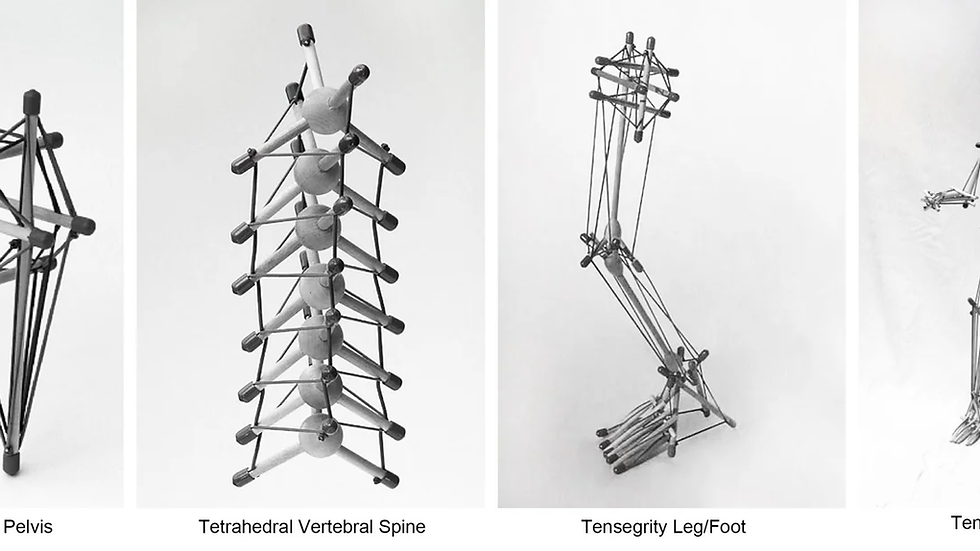
The emerging science of fascia—and the principle of biotensegrity—offers us a fundamentally different way of understanding the human body. Rather than a collection of separate parts that stack and hinge, the body is better understood as a continuous tensional network. Bones don't stack—they float, suspended within a web of connective tissue that distributes force, maintains integrity, and responds as a whole to every movement, every stress, every experience.
This web is fascia. And it changes everything.
What Is Fascia - and Why Does It Matter?
Fascia is the continuous sheet of connective tissue that wraps, separates, and connects every structure in the human body—every muscle, organ, nerve, and bone. It is not passive packaging. It is a living, dynamic, intelligent tissue that is richly innervated, highly responsive, and deeply involved in how we feel, how we move, and how we heal.
Fascia carries mechanoreceptors—sensory nerve endings that respond to pressure, stretch, vibration, and movement.
Among these are:
Ruffini endings—which respond to sustained pressure and are linked to nervous system down-regulation.
Golgi tendon organs—which mediate tissue release.
Pacinian corpuscles—fascinating receptors that respond to vibration and rapid changes in pressure.

This is why sound healing and myofascial release often work so powerfully in combination: both access the body's sensory intelligence through different but complementary pathways.
Fascia also maps onto what anatomist Tom Myers called Anatomy Trains—continuous lines of myofascial tissue that run throughout the body, connecting structures that conventional anatomy has always treated as separate. The superficial back line runs from the plantar fascia of the foot all the way to the forehead. The deep front line connects the inner arch of the foot to the jaw. When one part of a line is restricted, the entire chain is affected. This is why chronic neck tension may originate in the hips. Why jaw clenching connects to the pelvic floor. Why addressing the symptom alone never resolves the pattern.

Understanding fascia changes how you read your own body entirely. You stop looking for the problem in isolation and start reading the pattern as a whole.
The Missing Piece: The Nervous System
Here's what most conventional approaches miss entirely: fascia and the nervous system are inseparable.
The work of Dr. Stephen Porges and Polyvagal Theory has given us an extraordinary framework for understanding how the autonomic nervous system governs our sense of safety, connection, and capacity for healing. The body has three primary states: ventral vagal (safe, connected, regulated), sympathetic (mobilized, defensive, fight or flight), and dorsal vagal (collapsed, shutdown, dissociated).

Fascia reflects the nervous system's baseline state. Chronic sympathetic activation—caused by stress, trauma, or overwork—leaves the tissue held, braced, and guarded. No amount of mechanical manipulation will change this if the nervous system remains in a protective pattern.
This is why so many people plateau. The tissue releases and then returns. Because the tissue is following the nervous system, not the other way around.
Truly effective self-myofascial release works with the nervous system, not around it. Slow, sustained pressure—applied through the UNWIND™ tools with presence and awareness—speaks directly to the mechanoreceptors in the fascia, communicating safety to the nervous system and allowing the tissue to genuinely let go. This is not just a technique. It is a conversation between you and your own body's intelligence.
When the Body Holds Memory
One of the most important—and least talked about—dimensions of fascial work is its relationship to stored experience.
The body does not distinguish clearly between physical and emotional stress. Both are processed through the same nervous system, stored in the same tissue, and expressed through the same patterns of holding and bracing. A body recovering from a sports injury and a body carrying unresolved grief may hold remarkably similar tension patterns in the diaphragm, the psoas, and the jaw.
This is not metaphor. This is physiology.
When you begin to work with your own fascia—slowly, sustainedly, with genuine presence—you may find that a self-release session moves in unexpected directions. Emotions surface. Memories arise. The body begins to speak a language that goes beyond the physical complaint that started the practice.
This is not something to fear or manage away. It is the body doing exactly what it needs to do. But it is deeply valuable to understand what is happening—so that you can hold space for yourself with skill, grounding, and appropriate awareness.
This is what trauma-informed self-practice means in the context of the UNWIND™️ method. Not that every session becomes therapy. But that you are equipped to recognize, honor, and appropriately respond to the full intelligence of your own body.
The Power of Self-Release
Here is the belief at the heart of the UNWIND™️ method: you should not have to depend on anyone else to feel good in your own body.
The conventional model of healing places the power outside of you. You book an appointment. Someone works on your body. You feel better temporarily. And then you return—because the pattern that created the tension in the first place hasn't changed.
Self-myofascial release with the UNWIND™️ method turns this model on its head.
Using the UNWIND™ strip, massage balls, peanut ball, and easy grip balls, you learn to:
Identify your own restrictions.
Apply sustained, intentional pressure.
Release tension held for years—at your own pace, in your own home.
The UNWIND™️ method was born from exactly this recognition. Its founder spent years as an endurance athlete—two Comrades marathons, countless training miles—accumulating the kind of deep fascial holding that high-output sport creates. A hip injury that specialists couldn't diagnose and couldn't fix. And then a single experience with the UNWIND™️ strip that did what no clinical intervention had managed: it allowed her to find the exact site of her own pain, release it herself, and—with consistent practice—largely resolve it.
That experience wasn't just personally transformative. It revealed something fundamental: the most powerful healing is the kind you can do yourself, for yourself, from a place of genuine embodied understanding.
This is the philosophy at the heart of UNWIND™️.
What the UNWIND™ Practitioner Training Offers
The UNWIND™ Practitioner Training is a three-day immersive programme designed for movement teachers, yoga teachers, physiotherapists, personal trainers, bodyworkers, athletes, somatic therapists, and anyone who wants to go deeper into self-myofascial release—and learn to teach it to others.
It is not a workshop where you observe techniques and go home with a manual. It is a somatic education—one that begins with your own body and builds from there.
Over three days, you will explore:
Fascia science and anatomy as a lived framework.
Biotensegrity and fascial lines in movement and memory.
Nervous system education and Polyvagal Theory.
Hands-on techniques with UNWIND™ tools.
Breathwork and somatic integration.
Trauma-informed facilitation and teaching methods.
How to teach the UNWIND™️ method.
Whether you want to integrate self-myofascial release into your existing classes and workshops, lead dedicated UNWIND™️ sessions, or build a standalone offering around the method and tools.
You will leave with a full UNWIND™ tool kit, a printed course manual, a certificate of completion, and 20 Yoga Alliance Continuing Education hours.
But more than any of that—you will leave with a new relationship to your own body, and the confidence and knowledge to guide others into theirs.
A Different Kind of Practitioner
The wellness industry has a burnout problem. Teachers and therapists who give everything to their students and clients and have nothing left for themselves. Professionals who are technically skilled but have lost touch with their own embodied experience.
The UNWIND™️ method asks something different of its practitioners. It asks you to start with yourself. To know this work in your own body before you offer it to anyone else. To develop a self-release practice that resources you as deeply as it resources the people you teach.
Because when you are genuinely regulated, genuinely embodied, and genuinely at home in your own tissue—your teaching changes. You stop instructing from your head and start guiding from lived experience. And the people you teach feel that difference immediately.
That is the somatic pathway this training opens.
Is This Training for You?
This training is for you if you are a yoga teacher who wants to offer something deeper than asana. A physiotherapist who wants to empower clients with tools for self-care between appointments. A personal trainer whose athletes keep breaking down. A somatic therapist looking for a practical, tool-based method to complement your existing work. Or simply someone who has experienced the UNWIND™️ method yourself and wants to share it with others.
No prior myofascial release experience is required. What is required is genuine curiosity, a willingness to work with your own body, and an openness to a new way of seeing.
The Next Step
The UNWIND™ Practitioner Training runs periodically across South Africa and internationally. New South Africa dates are coming soon.
If something in this post has resonated—if you've felt the limitations of the conventional model, if you've wondered what it would mean to truly empower yourself and others with the tools for self-release, if your own body has been asking for attention—this may be the next right step.
You can find full details and to register:
Or simply reach out. We'd love to hear where you are in your practice, and whether this training feels like the right fit.
One participant shared:
Unwind was one of the most beneficial trainings I’ve ever experienced. A powerful, nourishing modality. I was amazed that I could finally access a deep, painful restriction in my hip that had been troubling me for over six years. Natalie is an exceptional teacher. She has a beautiful way of guiding the process, making everything feel natural, safe & empowering. I feel incredibly grateful & I’m super excited to begin sharing it with others. *~ Jayne Holtzhausen ~*
The body has been asking. This is how you learn to listen - and how you learn to teach others to do the same.
UNWIND™ with Myofascial Release is a South African somatic education brand offering practitioner trainings, workshops, and self-release tool kits for anyone who wants to work more intelligently with their own body.

Comments